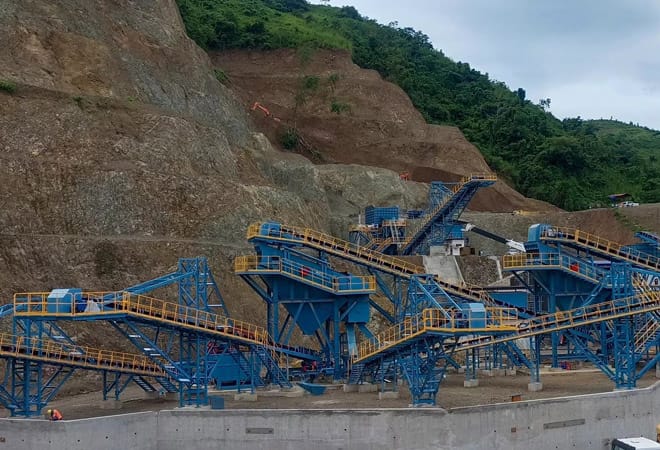
В производстве щебня, горнодобывающей промышленности и проектах по переработке строительных отходов процесс дробления, как правило, состоит из нескольких этапов. Среди них первичное и вторичное дробление являются наиболее важными этапами для получения щебня желаемого размера и качества.
При проектировании дробильно-сортировочной установки многие заказчики часто задают следующий вопрос:
На самом деле эти два этапа дробления преследуют разные цели и совместно определяют производственную мощность, качество щебня, гранулометрический состав и общие эксплуатационные расходы.
В данной статье объясняются основные различия между первичным и вторичным дроблением, а также приводятся рекомендации по выбору наиболее подходящего дробильного оборудования для вашего проекта.
Первичное дробление — это первый этап процесса дробления щебня. Его основная цель заключается в измельчении крупных кусков сырья, добытого из карьеров или шахт, до размеров, пригодных для дальнейшей переработки.
К распространенным видам сырья относятся:
Типичные размеры корма варьируются в пределах:
После первичного дробления размер частиц, как правило, уменьшается до 100–300 мм.
Первичные дробилки способны перерабатывать крупнозернистый сырой материал (ROM) непосредственно из карьеров или горнодобывающих предприятий.
Крупные камни можно быстро измельчить до размеров, подходящих для последующих этапов дробления.
Оборудование первичного дробления принимает на себя основную нагрузку по подаче материала на всей дробильной установке.
Оборудование должно выдерживать постоянные ударные нагрузки и суровые условия эксплуатации.
Щековая дробилка является наиболее широко используемой дробилкой первичного дробления в сфере добычи полезных ископаемых и производства щебня.
К основным преимуществам относятся:
Вторичное дробление — это этап, на котором после первичного дробления происходит дальнейшее измельчение и доработка материала с целью получения продукта требуемого размера и формы.
Его основная задача заключается в измельчении крупного материала, полученного на первичной дробилке, до конечного размера заполнителя, требуемого проектом.
Например:
Вторичное дробление обеспечивает более равномерное распределение частиц по размерам и лучшую форму заполнителя.
Правильное вторичное дробление снижает нагрузку на последующее просеивающее оборудование.
Вторичное дробление широко применяется для производства заполнителей, предназначенных для:
Secondary crushing plays a crucial role in determining the final quality of aggregates. Well-shaped aggregates with low flakiness and elongation can reduce cement consumption and improve concrete strength in concrete batching plants.
Cone crushers operate based on the principle of lamination crushing, where materials are compressed, sheared, and bent between the moving mantle and the stationary concave.
Advantages include:
Impact crushers use a high-speed rotor equipped with blow bars to strike incoming materials. The material is repeatedly impacted against impact plates until the desired size is achieved.
Advantages include:
| Comparison Item | Primary Crushing | Secondary Crushing |
| Crushing Stage | Stage 1 | Stage 2 |
| Material Processed | Large raw rock | Material after primary crushing |
| Feed Size | 500–1500 mm | 100–300 mm |
| Output Size | 100–300 mm | 20–80 mm |
| Main Purpose | Reduce large rocks | Refine particle size and shape |
| Typical Equipment | Jaw Crusher | Cone Crusher / Impact Crusher |
| Equipment Load | High-impact, heavy-duty | Fine crushing and shaping |
More about: How to Choose the Right Crusher Type for Different Materials
Many newcomers to the crushing industry ask:
“Can a single crusher complete the entire process from raw stone to finished aggregate?”
In most cases, the answer is no. Multi-stage crushing is required for the following reasons:
The reduction ratio of a single crusher is usually limited to approximately 6:1 to 8:1.
For example, reducing 1500 mm raw stone directly into 10 mm aggregate would require a total crushing ratio of 150:1, which cannot be achieved efficiently by a single machine.
Different crushing methods are suitable for different material sizes.
Using one crusher for all stages results in higher energy consumption and lower productivity.
Different construction applications require specific aggregate gradations.
By combining staged crushing with screening equipment, operators can precisely control the proportions of finished aggregate products.
Primary crushers are designed to withstand large feed sizes and heavy impacts.
Secondary crushers focus on particle shaping and fine reduction.
Dividing these tasks among different machines significantly improves equipment reliability and service life.
When selecting crushing equipment, consider the following factors:
Recommended configuration:
Feeder → Jaw Crusher (Primary Crushing) → Cone Crusher (Secondary Crushing) → Vibrating Screen → Finished Aggregate
Recommended configuration:
Feeder → Jaw Crusher (Primary Crushing) → Impact Crusher (Secondary Crushing) → Vibrating Screen → Finished Aggregate
The finer the required final product, the more important a multi-stage crushing process becomes.
Например:
Feeder → Jaw Crusher → Cone Crusher / Impact Crusher → Vertical Shaft Impact (VSI) Crusher → Vibrating Screen → Manufactured Sand
(The VSI crusher is commonly used for tertiary crushing and particle shaping to produce high-quality manufactured sand.)
Learn more about crushing plant design and equipment selection:
How to Design an Efficient Crushing and Screening Plant
As a professional manufacturer of crushing and screening equipment, Runhang provides complete solutions for aggregate production, mining, and recycling applications.
Our product range includes:
Based on raw material characteristics, production requirements, and finished product specifications, Рунханг delivers customized crushing solutions that help customers achieve higher productivity, superior aggregate quality, and lower operating costs.
Primary crushing and secondary crushing serve different but equally important functions in the aggregate production process.
Primary crushing reduces large raw materials into manageable sizes for further processing, while secondary crushing refines particle size and improves aggregate shape to meet project specifications.
By selecting the appropriate combination of crushers and configuring the crushing process correctly, operators can improve production efficiency, reduce operating costs, and produce high-quality aggregates for a wide range of construction and mining applications.