Automation has become an important part of modern concrete batching plant operation. Instead of relying heavily on manual weighing, material feeding, mixing, and production records, an automated system can coordinate these processes through sensors, controllers, weighing systems, and operator interfaces.
A typical automated concrete batching plant uses a combination of PLC control, HMI or SCADA interfaces, weighing sensors, actuators, and control software to monitor and manage the production process.
For ready-mix producers, contractors, and infrastructure projects, concrete batching plant automation can help improve production consistency, reduce manual intervention, simplify operation, and provide better production data.
Concrete batching plant automation is a control system designed to automatically manage key stages of concrete production.
Depending on the plant configuration, an automated system can coordinate:
The basic principle is a continuous “detection → control → execution” process.
Sensors collect information such as material weight and equipment status. The PLC processes these signals according to programmed logic, while motors, valves, conveyors, and other actuators perform the required actions. The operator can monitor the process through an HMI, industrial computer, or SCADA interface.
A complete automation system normally consists of several interconnected components.
The Programmable Logic Controller (PLC) is the core control unit.
It receives signals from sensors and weighing systems and executes the programmed production sequence. The PLC can coordinate aggregate gates, conveyors, screw conveyors, water pumps, admixture systems, mixer motors, and discharge gates.
Modern PLC-based systems can also support fault detection, interlocks, equipment status monitoring, and system expansion.
The Human-Machine Interface (HMI) allows operators to interact with the plant control system.
A more comprehensive SCADA system can provide centralized monitoring of equipment and production information, including:
This gives operators a clearer view of plant operation from a centralized workstation.
Load cells and other sensors provide the system with real-time information about material quantities and equipment conditions.
Accurate weighing is particularly important because aggregate, cement, water, and admixtures need to be dosed according to the selected mix recipe.
The actual achievable accuracy depends on the equipment, calibration, material characteristics, and operating conditions, so manufacturers should specify performance based on the complete weighing system rather than a single sensor.
The automation system also controls physical equipment, including:
These components execute commands from the control system and complete the physical production process.
One of the most important automation functions is automatic material batching.
After the operator selects a mix recipe, the system can automatically control the required material sequence and target quantities.
This reduces the need for operators to manually calculate and control every material addition.
Modern control systems can store multiple concrete mix recipes.
Operators can select the appropriate recipe according to the required concrete grade or project specification.
Recipe management can help standardize production and reduce the risk of entering the wrong material quantities manually.
Recipes should still be controlled by authorized personnel and verified against the project’s approved mix designs.
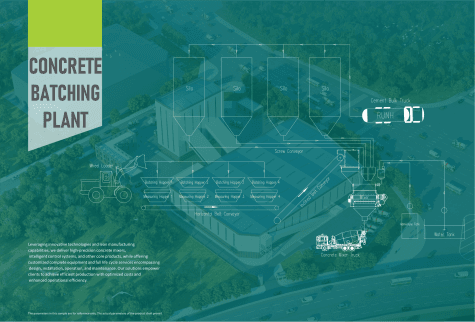
Automation can coordinate the complete production sequence.
A typical cycle may include:
Aggregate Batching → Cement Batching → Water & Admixture Dosing → Feeding → Mixing → Discharge
The control system can coordinate the timing and sequence of these operations according to programmed parameters.
This helps reduce unnecessary manual intervention and makes batch cycles more consistent.
Operators can monitor the production process through an HMI or SCADA interface.
Important information may include:
Real-time monitoring can help operators identify abnormal conditions earlier and respond more quickly.
An automated plant can monitor equipment and process conditions and generate alarms when predefined abnormal conditions occur.
Examples include:
A well-designed alarm system should provide useful information without overwhelming operators with unnecessary alerts.
Automation can record production information for later review.
Depending on the system configuration, records may include:
Production records can help plant managers analyze operating performance and maintain better traceability.
Many batching plant control systems support both automatic and manual modes.
Automatic mode is suitable for normal production, while manual operation can be useful for:
The exact operating modes depend on the automation architecture and software configuration.
Automated weighing and sequencing can reduce variations caused by manual operation.
When the same approved recipe and operating parameters are used consistently, the production process becomes more repeatable.
This is particularly useful when a plant produces different concrete mixes throughout the day.
Automation coordinates multiple pieces of equipment within a production cycle.
Instead of requiring operators to manually control each stage, the control system can execute programmed sequences and allow operators to focus on monitoring and exceptions.
This can help improve workflow efficiency and reduce unnecessary waiting between production stages.
Automation can reduce repetitive manual tasks such as:
However, automation does not eliminate the need for trained operators. Operators remain important for supervision, troubleshooting, maintenance coordination, and responding to abnormal conditions.
Digital production records can provide a history of what was produced, which recipe was used, and how much material was consumed.
This information can be useful for production management, quality control, inventory planning, and troubleshooting.
Automated monitoring can identify certain abnormal equipment or process conditions and alert operators.
This can make troubleshooting more systematic and potentially reduce the time required to identify the source of a problem.
Accurate batching and production records can also help plant managers understand material consumption and identify waste.
For example, production data can be compared with planned material consumption to identify unusual deviations.
Automation can be used in different types of concrete production environments.
Ready-mix plants often produce multiple concrete mixes for different customers and construction projects.
Recipe management, automated batching, production records, and truck-loading coordination can be particularly useful in this environment.
Precast plants require repeatable mix production because concrete is used to manufacture standardized or project-specific components.
Automation can help maintain consistent batching and simplify repeated production cycles.
Large infrastructure projects may require substantial volumes of concrete over extended periods.
Automated control can help organize production, monitor output, and maintain production records.
For temporary or project-specific plants, automation can simplify daily operation while allowing operators to monitor production from a centralized control station.
Mobile batching plants can also use automated control systems, although the automation configuration needs to consider the plant’s compact design, transportation requirements, power supply, and project conditions.
Automation can contribute to concrete quality by controlling material quantities and production sequences more consistently.
However, automation alone does not guarantee high-quality concrete.
Concrete quality also depends on:
For example, changes in aggregate moisture can affect the effective water content of a mix. An automation system can help manage the relevant inputs, but appropriate sensors, calibration, mix-design procedures, and operator oversight are still required.
Related Reading: What Factors Affect Concrete Quality in a Batching Plant?
Automation can also support more efficient plant operation.
By coordinating equipment startup and shutdown, reducing unnecessary idle running, and monitoring production cycles, the control system can help reduce avoidable equipment operation.
For example, conveyors, pumps, and other auxiliary equipment do not always need to run continuously when production is paused.
Energy monitoring and production data can also help operators identify equipment or operating conditions that require further investigation.
Related Reading: How to Reduce Energy Consumption in a Concrete Batching Plant
More advanced automation systems may support remote monitoring and data connectivity.
Depending on the system architecture, plant managers may be able to access:
Some systems can integrate with higher-level management or enterprise software.
However, remote functions should be designed with appropriate access control, network security, and operational safeguards.
Before selecting a concrete batching plant automation system, consider the following factors:
The control system should be suitable for the plant’s production capacity and number of material handling systems.
Consider the number of aggregate bins, cementitious materials, water sources, and admixture systems that need to be controlled.
Determine whether a PLC, HMI, SCADA, or a combination of systems is appropriate for the project.
The automation system should work with a reliable weighing system and provide suitable calibration and monitoring functions.
If production reports and traceability are important, choose a system with suitable data storage and reporting capabilities.
Future additions such as extra silos, conveyors, material bins, or production lines should be considered during the initial system design.
The interface should be practical for daily operation, while operators should receive proper training in normal operation, alarms, manual control, and emergency procedures.
Related Reading: Concrete Batching Plant Layout Design: Key Factors for Efficient Operation
| Automation Area | Key Considerations |
| PLC | Reliable control and sufficient I/O capacity |
| HMI/SCADA | Clear monitoring and easy operation |
| Weighing | Accurate sensors and regular calibration |
| Recipe management | Controlled and easy-to-use mix recipes |
| Sequencing | Automatic batching, mixing, and discharge |
| Alarms | Clear fault identification and notifications |
| Data recording | Batch, material, and production records |
| Manual mode | Maintenance and troubleshooting support |
| Remote monitoring | Secure access and appropriate permissions |
| Expansion | Capacity for future equipment or production lines |
| Training | Operators understand automatic and manual operation |
Concrete batching plant automation is more than simply replacing manual operation with a computer. A well-designed automation system connects weighing, material handling, mixing, equipment control, monitoring, alarms, and production data into one coordinated process.
The main value of automation lies in making production more consistent, reducing repetitive manual tasks, improving process visibility, and providing useful production data.
For new plants, automation should be considered together with equipment selection, plant layout, production capacity, and future expansion plans. For existing plants, upgrading the control system can also be an option when the existing system becomes difficult to maintain or no longer meets production requirements. Control-system migration projects commonly combine PLC, HMI/SCADA, weighing interfaces, engineering, commissioning, and operator training.
Runhang provides concrete batching plant equipment and customized solutions for different project requirements. By combining suitable mechanical equipment with an appropriate control system, concrete producers can build a more organized, efficient, and manageable production process.