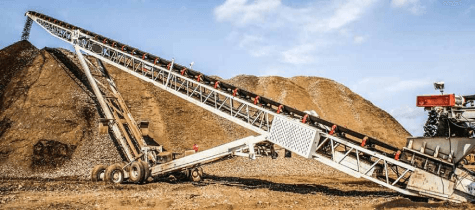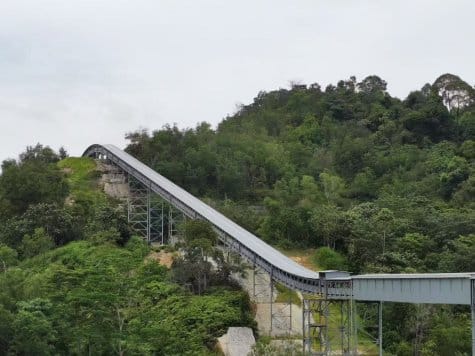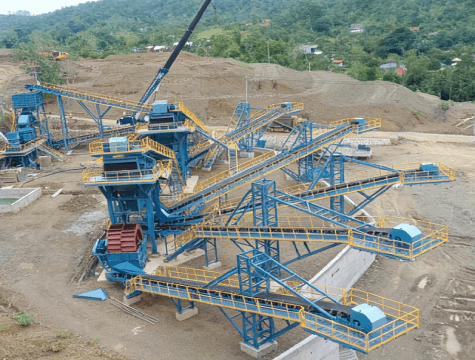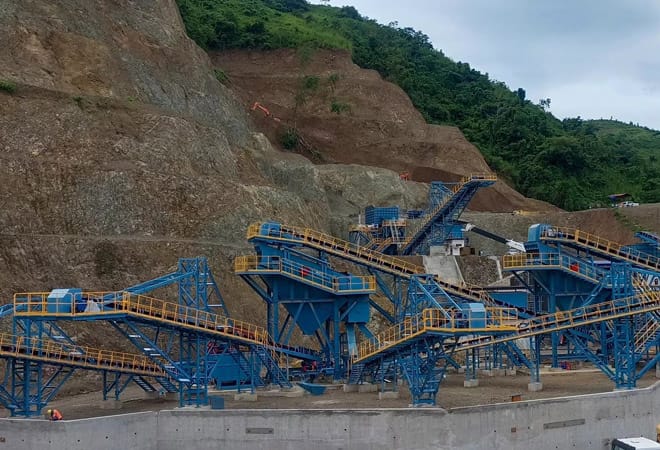
In industries such as mining, sand and gravel aggregates, cement, and concrete production, belt conveyors are essential equipment for achieving continuous, efficient material handling. Across multiple crushing plant and mixing station projects undertaken by Runhang, we have observed that even when conveyors meet design parameters during the selection phase, material spillage issues may still arise during operation.
In our previous article, How to Choose the Right Belt Conveyor for Your Project, we outlined the key factors to consider during conveyor selection. This piece will further focus on a more field-specific issue: the common causes of material spillage from belt conveyors and an analysis of their underlying factors.
Material spillage from belt conveyors refers to the phenomenon where material fails to remain stably within the effective width of the conveyor belt during transport, instead scattering onto the ground or equipment structures from either side of the belt, loading points, or transfer points.
Within mining and aggregate production lines, belt conveyors serve a vital role in linking crushing, screening, and finished product stockpiling operations. As highlighted in Runhang’s publication The Role of Belt Conveyors in Mining and Construction, any instability in the conveying stage frequently exerts a direct impact on the continuous operation of the entire production line.
When the actual throughput exceeds the design capacity of a belt conveyor, the accumulation height of material on the belt increases significantly, making it highly susceptible to spillage from both sides. This situation frequently occurs in projects where conveying capacity has been increased without synchronous adjustment of the conveying system.
In Runhang’s engineering practice, we typically recommend incorporating a reasonable margin for conveying capacity during the system design phase to prevent long-term spillage issues arising from short-term overloading.
An ill-conceived loading point design is one of the typical causes of material spillage. Should material tend to accumulate on one side of the conveyor belt during discharge, this will result in uneven loading, ultimately leading to persistent spillage.
This issue manifests differently in different conveying methods. Mobile conveyors, due to their flexible layout, have higher requirements for the location and alignment accuracy of loading points. For more information, please refer to Fixed vs. Mobile Belt Conveyors: Which Is Better for Mining and Crushing Plants.
One common cause of edge spillage is belt misalignment, which leads to material gradually accumulating on one side. Contributing factors typically include misaligned idler installation, improper tensioning, or uneven frame foundations.
Runhang recommends implementing reliable belt alignment measures at critical points, combined with regular inspections, to ensure long-term stable operation of the conveyor belt.
Transfer points are the locations most prone to material spillage and scattering. Should chute angles or buffer designs prove inadequate, materials are susceptible to rebound and overflow under high-velocity impact.
Within Runhang’s EPC projects, transfer points are typically prioritised as key optimisation areas to mitigate impact forces, reduce material spillage, and address dust-related issues.
Side seals and sidewalls are employed to confine material within the belt’s width during operation. Should they become worn or improperly fitted, their containment effectiveness diminishes markedly, particularly under high-capacity continuous operation conditions.
The conveyance of wet, sticky, fine powdered materials or those with an uneven particle size distribution is more prone to generating unstable flow, thereby increasing the risk of spillage.
Material spillage from belt conveyors is rarely caused by a single issue, but rather results from the combined effects of multiple factors, including model selection, structural design, installation precision, and operational management. Through systematic analysis and targeted optimisation, the majority of spillage problems can be effectively controlled.
As an engineering equipment manufacturer and solutions provider, Runhahng possesses extensive project experience in crushing plants, concrete batching plants, and conveying systems. We assist clients in optimising conveying systems from a holistic process perspective, thereby enhancing production line stability and operational efficiency.