In mining operations, aggregate processing, and building materials production, efficient crushing and screening production lines are pivotal for maintaining stable output, reducing operational costs, and enhancing product quality. As a specialist supplier of crushing plants, concrete batching plants, and complete engineering solutions, Runhang has developed a mature design philosophy through project implementation across numerous countries and regions.
This article will systematically analyse how to construct efficient, practical production lines, focusing on aspects such as system planning, process flow, layout design, and equipment coordination.
The first step in designing an efficient production line is to fully comprehend the raw material conditions and final product requirements.
Different aggregates exhibit significant variations in hardness, moisture content, particle size distribution, and abrasiveness. These factors directly influence the selection of crushing methods and process configuration. For instance, large bulk materials typically require a robust primary crushing system, while projects demanding high-quality finished particle shapes necessitate targeted optimisation in subsequent crushing stages. During the system planning phase, a rational approach to crusher configuration helps ensure seamless integration between subsequent processing stages. Further guidance can be found in Runhang‘s How to Choose the Right Crusher Type for Different Materials.
Concurrently, design capacity should be determined based on continuous, stable operating conditions rather than the maximum throughput of individual equipment. This approach prevents localised system overload or capacity wastage.
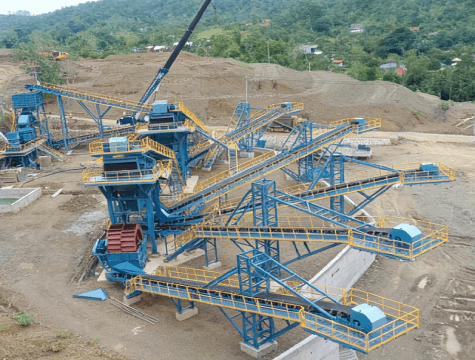
A mature crushing and screening production line typically comprises multiple stages, including feeding, crushing, screening, and conveying, with each section requiring a smooth, continuous material flow.
The primary crushing stage reduces large raw material chunks to manageable sizes, with emphasis on ensuring uniform feed and stable equipment loading. During secondary and tertiary crushing, screening equipment effectively classifies materials and establishes closed-circuit circulation to guarantee precise control of final product particle size. Scientific screening configurations separate materials by particle size for output or return to the crushing cycle. This approach enhances throughput while minimising unnecessary re-crushing, ensuring capacity matching across equipment stages and process continuity. Consequently, stable material flow and efficient production are achieved.
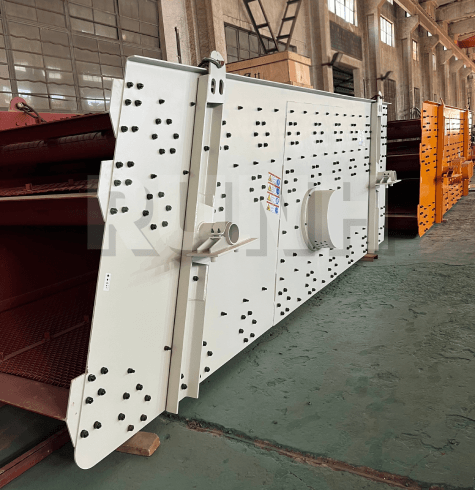
This process design philosophy is intrinsically linked to the role of vibrating screens within crushing and screening systems. A well-designed screening solution is often pivotal to enhancing the overall efficiency of the production line. For further details on vibrating screens, please refer to How to Choose a Vibrating Screen for a Crushing Plant: Types, Capacity & Applications.
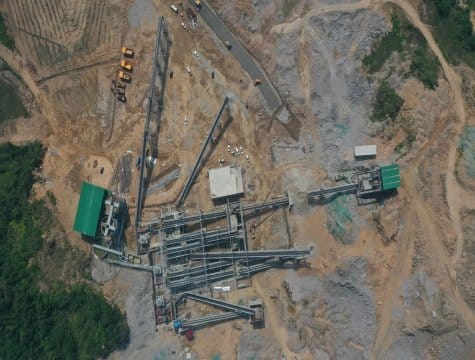
Layout design directly impacts the coordination efficiency between equipment, material conveyance distances, and the convenience of routine maintenance.
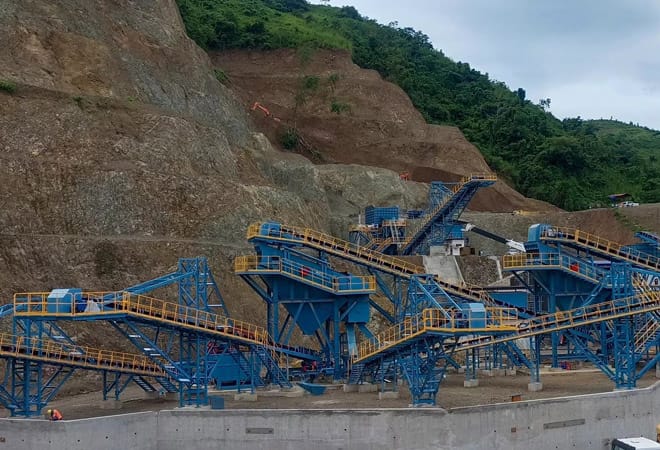
Optimising terrain conditions and height differentials can shorten conveyance distances, reduce energy consumption, and minimise material loss during transhipment. Throughout this process, the conveying system plays a vital role in connecting various process stages, with its rational layout directly affecting the continuity and stability of the entire production line.
When arranging equipment, full consideration must be given to routine inspection and maintenance requirements, ensuring sufficient operational and maintenance clearance is provided. Favourable maintenance conditions not only minimise downtime but also extend the overall service life of the equipment.
The crushing, screening and conveying systems must be fully integrated:
To ensure the long-term stable operation of crushing and screening systems, attention must also be paid to the following design and operational details:
Employing vibrating feeders and constant-speed feeding designs enables crushers to operate under ideal load conditions, enhancing efficiency and reducing fluctuations.
Implementing PLC or intelligent control systems facilitates coordinated control of crushers, screens, feeding, and conveying systems, optimising operational efficiency.
Implement scheduled inspection protocols and promptly replace wear components such as crusher liners, screen meshes, and conveyor belts to minimise downtime and maintenance expenditure.

In contemporary crushing and screening projects, environmental protection and sustainable operation have become indispensable design considerations.
Through dust control measures, noise-optimised layouts, and energy-efficient system configurations, not only can the on-site working environment be improved, but long-term project compliance is also facilitated.
A well-designed system can meet production capacity requirements while achieving a more balanced control of energy consumption and maintenance costs.
An efficient crushing and screening production line is the result of the combined effects of process design, equipment matching, and system layout. By starting from material characteristics, rationally planning processes, optimising layouts, and emphasising system coordination, it is possible to create a production system that is stable in operation, maintenance-friendly, and capable of expansion.
Leveraging its project experience in crushing and screening engineering, Runhanng is committed to providing customers with more efficient and reliable integrated solutions, helping mining and aggregate production projects achieve long-term stable operation.