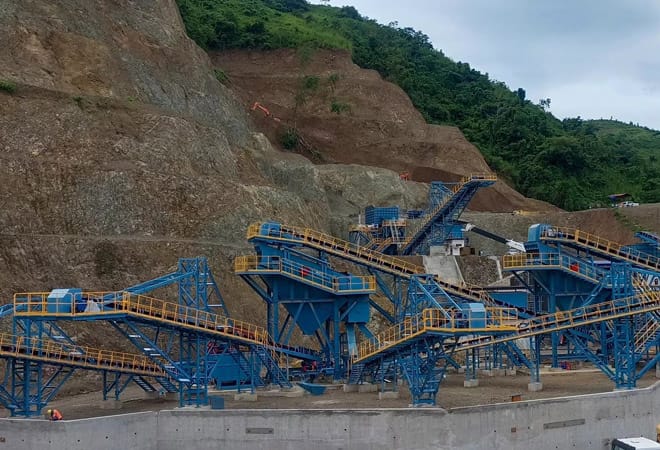
How to Choose the Right Crusher Type for Different Materials
Release Time: 2025-11-11
Read: 917
Share:
Introduction
The first step in selecting a crusher is to define the production objectives. Different projects have varying requirements for output volume, particle size, discharge shape, and operating environment.
Production Capacity: Calculate the required hourly or daily output based on project scale to avoid equipment underperformance or excessive redundancy leading to waste. Examples include 50 tonnes per hour, 150 tonnes per hour, or 250 tonnes per hour.
Output Particle Size Requirements: Specify the target particle size range and shape specifications for the final crushed product. For instance, aggregates for road sub-base may tolerate coarser particle sizes, whereas sand for concrete requires finer, cuboid-shaped particles.
Material Type: Determine whether the material to be crushed is hard, abrasive rock such as granite or basalt; medium-soft rock like limestone or shale; or recyclable material, including concrete and asphalt. Additionally, confirm key material properties such as moisture content, stickiness, and clay content.
Site Conditions: Fixed production line or mobile crushing plant?
Clarifying these parameters establishes the correct direction for subsequent equipment selection.
Basic Methods for Reducing Material Size
Compression Crushing: Material is crushed between two opposing surfaces, fracturing it due to insufficient compressive strength. Suitable for hard, abrasive materials such as granite and iron ore. Jaw crushers, cone crushers, and gyratory crushers all operate on this principle.
Impact Crushing: Achieves fragmentation by high-velocity components (e.g., hammers, rotors) striking the material or by causing material-to-material collisions. Suitable for medium-soft materials, it produces cuboid-shaped products. Impact crushers and hammer crushers are typical examples.
Shear Crushing: Employing shear forces to sever or tear materials. Often combined with other crushing methods, it is suitable for processing highly viscous or tough materials. Roller crushers incorporate shear action during operation.
Grinding Crushing: Achieving refinement through friction and grinding between materials or between materials and equipment components. Suitable for scenarios requiring ultra-fine crushing, some tertiary crushing equipment incorporates grinding principles.
Types of Crushers and Their Applications
Jaw Crusher
Purpose: Primary crushing, processing hard rock or large blocks of stone.
Features: Simple structure, easy maintenance, suitable for granite, basalt, etc.
Cone Crusher
Purpose: Secondary or tertiary crushing.
Characteristics: Produces well-shaped output, high efficiency, suitable for medium to high hardness rocks.
Impact Crusher
Purpose: Crushing medium-hard materials such as limestone and construction waste.
Characteristics: High cubicity of output, suitable for concrete aggregate production.
Vertical Shaft Impact Crusher (VSI Crusher)
Application: Manufactured sand and fine crushing.
Features: Excellent output particle shape, widely used in sand and gravel shaping processes.
Hammer Crusher
Application: Medium crushing of brittle materials.
Features: Simple structure, low cost, but prone to rapid wear.
Key Considerations for Selection
Before deciding on a crusher type, the following aspects should be prioritised:
Material characteristics: hardness, moisture content, and clay content.
Final product requirements: particle size distribution, shape, powder content.
Equipment maintenance and replacement cycles for wear parts.
Energy consumption versus production capacity matching.
Equipment compatibility: Integration with systems such as vibrating screens, conveyor belts, and feeders.
Matching Crusher Type to Material Characteristics
Consider Costs
Procuring a crusher represents a significant investment requiring careful consideration of both upfront costs and long-term operational expenses to maximise value for money.
Initial procurement costs: Prices vary considerably between crusher types. Spring cone crushers offer lower costs, while multi-cylinder hydraulic cone crushers and large gyratory crushers command higher prices. Selection should be based on budgetary constraints and production capacity requirements.
Long-Term Operational Costs: Calculate energy consumption, replacement costs for wear parts, and maintenance expenses. For instance, hydraulic crushers consume 15%-30% less energy than spring-type crushers, significantly reducing long-term energy expenditure.
Investment Redundancy Planning: Should future capacity expansion be required, reserve approximately 30% capacity redundancy during selection to avoid additional investment in secondary equipment upgrades.
Let Runhang Be Your Machinery Partner
Selecting the appropriate crusher is a complex system engineering task involving multiple professional dimensions. Leveraging years of industry experience and professional expertise, Runhang provides you with a one-stop solution, making selection and operation more hassle-free.
Precision Matching Recommendations: Our professional team will thoroughly understand your material characteristics, production targets, site conditions, and budget range to tailor-recommend the most suitable crusher type and model, avoiding blind selection.
End-to-End Service Support: From equipment selection and on-site installation/commissioning to operator training, spare parts supply, and remote maintenance, we deliver full lifecycle services ensuring rapid commissioning and sustained, stable operation.
Flexible Partnership Options: Tailored procurement, leasing, and financing solutions for projects of varying scales help optimise capital allocation and mitigate investment risks.
Customised Technical Upgrades: Tailored to your specific production requirements, we offer bespoke equipment modifications such as optimised crushing chamber designs and upgraded automated control systems to enhance compatibility and production efficiency.
Whether processing quarry aggregates, construction waste, or mineral ores, Runhang delivers efficient, durable, and cost-effective solutions.
Conclusion
Selecting the appropriate crusher type is a critical factor in enhancing production efficiency, reducing operational costs, and ensuring product quality. This requires a comprehensive assessment of multiple factors, including specific operational requirements, material characteristics, crushing principles, equipment performance, and budgetary constraints. Optimal crusher types vary depending on the material: hard materials suit compression crushers, medium-soft materials benefit from impact or hammer crushers, while damp, sticky materials require dedicated anti-clogging equipment. Through scientific selection and rational configuration, you can not only boost production efficiency but also extend equipment lifespan and reduce energy consumption.
As your dedicated mechanical partner, Runhang remains committed to delivering precise, efficient, and hassle-free crushing solutions. Whether your enterprise operates in mining extraction, construction aggregate production, or resource recovery, our extensive industry expertise and professional technical support will guide you in selecting and optimising equipment to secure a competitive edge. Should you require assistance with crusher selection, please do not hesitate to contact us. Together, let us pioneer new frontiers in high-efficiency production.