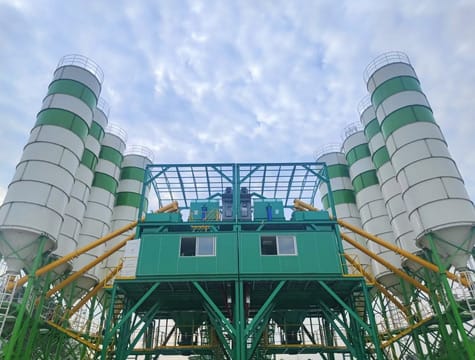
Choosing the right concrete batching plant capacity is an important part of project planning and equipment selection.
Before choosing the right batching plant capacity, it is helpful to understand how the concrete batching process works. The following video shows the main stages of aggregate loading, material batching, mixing, and concrete discharge.
YouTube Video: How Does a Concrete Batching Plant Work?
Therefore, batching plant capacity should not be selected based only on the rated output. Project size, concrete demand, peak production requirements, construction schedule, transportation capacity, and future requirements should all be considered.
This guide explains the key factors to consider when selecting the right concrete batching plant capacity for a project.
Concrete batching plant capacity is commonly measured in m³/h (cubic meters per hour) and indicates how much concrete the plant can theoretically produce within one hour.
However, the rated capacity and actual production output are not always the same.
Actual output can be affected by:
For this reason, plant capacity should be selected based on realistic operating conditions rather than theoretical output alone.
The first step is to estimate the total amount of concrete required for the project.
This may include:
Projects with large concrete volumes and short construction schedules generally require higher production capacity.
Total concrete volume is only one part of the calculation.
The more important question is:
How much concrete is required per hour during peak construction periods?
For example, a project may have an average demand of 50 m³/h but require significantly higher output during foundation work or continuous concrete pouring.
Consider:
The batching plant should be capable of meeting the major peak production requirements.
The construction schedule also affects the required plant capacity.
A project with a longer construction period may be able to meet its total concrete requirement with a lower hourly output.
In contrast, projects that need to complete large concrete pours within a short period may require a higher-capacity plant.
Consider:
Total concrete volume + construction schedule + daily operating hours + peak demand
rather than relying only on total project volume.
The rated capacity of a batching plant is usually calculated under ideal operating conditions.
In actual production, loading, mixing, discharging, transportation, maintenance, and other factors can reduce effective output.
Therefore, it is advisable to maintain a reasonable capacity margin.
If peak demand is already close to the plant’s maximum theoretical output, continuous operation at full capacity may increase operational pressure and maintenance requirements.
A reasonable capacity margin can help improve production stability.
Batching plant capacity is not the only factor affecting overall concrete production efficiency.
If the plant can produce concrete faster than trucks can transport it to the jobsite, production may still be interrupted.
Consider:
Batching, transportation, and placing capacity should be properly matched.
Different projects may require different production capacities.
Projects with relatively low concrete demand may use a smaller batching plant to reduce initial investment and operating costs.
These projects often require a continuous supply of concrete and may benefit from higher production capacity and reliable operation.
For projects involving long periods of continuous concrete pouring, peak demand, production continuity, and equipment reliability should be carefully evaluated.
The right capacity should therefore be determined by actual production requirements rather than project type alone.
A batching plant cannot achieve its rated output if cement, aggregates, or other materials are not supplied consistently.
Make sure that:
Cement storage capacity should also be matched with plant output and material replenishment schedules.
Related Reading: How to Choose Cement Silo Capacity
If a company expects to take on larger projects in the future, selecting equipment based only on current demand may result in insufficient capacity later.
Where the budget and site conditions allow, consider future production requirements and potential expansion.
A modular or expandable plant design can provide greater flexibility as production needs change.
Related Reading: Modular Design in Concrete Batching Plants and Crushing Lines
A practical selection process can follow these steps:
Step 1: Estimate total concrete demand
↓
Step 2: Determine average daily and hourly demand
↓
Step 3: Calculate peak concrete demand
↓
Step 4: Consider actual operating efficiency
↓
Step 5: Match truck and placing capacity
↓
Step 6: Check raw material and storage capacity
↓
Step 7: Allow reasonable capacity margin and future expansion
This approach provides a more reliable basis for selecting batching plant capacity than simply choosing the highest-rated equipment.
Runhang provides concrete batching plant solutions for construction, road, bridge, infrastructure, and industrial projects.
Based on project size, concrete demand, construction schedule, site conditions, and production requirements, Runhang can help customers select suitable batching plant configurations.
The overall system can be designed with consideration for mixing, aggregate handling, cement storage, weighing, conveying, and control systems.
Proper capacity planning and equipment configuration can help improve concrete supply reliability while avoiding unnecessary investment and operating costs.
Choosing the right concrete batching plant capacity requires more than looking at the plant’s rated output.
Project owners and contractors should consider total concrete demand, peak hourly requirements, construction schedules, transportation capacity, raw material supply, and future production needs.
The goal is to properly match batching capacity with concrete transportation and placing capacity while maintaining a reasonable production margin.
With proper capacity planning, a concrete batching plant can provide more stable concrete supply, reduce waiting and downtime, and improve overall project efficiency.
Related Reading: Concrete Batching Plant Price Guide: What Affects the Cost?