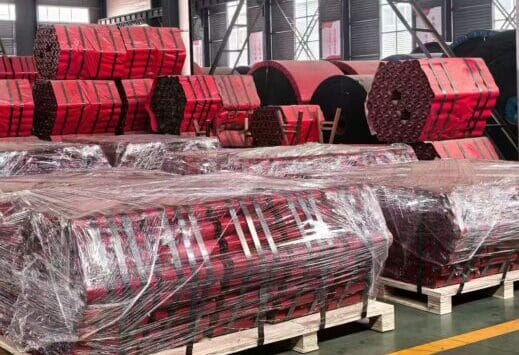
Conveyor idlers are essential components of a belt conveyor system. They support the conveyor belt, carry material loads, maintain belt shape, and help ensure smooth and stable operation.
Different conveyor positions and operating conditions require different idler types. Selecting an unsuitable idler may lead to premature bearing failure, excessive belt wear, material spillage, belt misalignment, and increased maintenance costs.
This article explains the main types of conveyor idlers and the key factors to consider when selecting the right idler for your belt conveyor system.
A conveyor idler is a rotating roller or roller assembly installed along a belt conveyor. It supports the conveyor belt and, depending on its position, carries material loads, maintains belt alignment, or supports the return side of the belt.
A typical belt conveyor system uses multiple idlers distributed along its carrying and return sections. The quality and correct selection of idlers directly affect conveyor stability, operating resistance, belt service life, and maintenance requirements.
2.1 Carrying Idlers
Carrying idlers are installed along the upper section of a belt conveyor to support the loaded belt and transported materials. Troughing idlers usually consist of three rollers arranged to form a trough, helping contain bulk materials and increase carrying capacity. Flat carrying idlers support a flat belt and are commonly used in light-duty or special conveying applications. Troughing idlers are widely used in mining, aggregate production, and crushing plants.
2.2 Return Idlers
Return idlers support the empty conveyor belt as it travels back from the discharge end to the loading end. Common types include flat return idlers, V-return idlers, and rubber disc return idlers. For sticky or wet materials, rubber disc return idlers can help reduce material buildup.
2.3 Impact Idlers
Impact idlers are installed beneath conveyor loading points, where falling materials create significant impact forces. They typically use rubber rings or other cushioning structures to absorb impact energy and protect the belt. They are suitable for crushing plants, mining operations, and aggregate production lines.
2.4 Self-Aligning Idlers
Self-aligning idlers help correct conveyor belt tracking deviations. They can rotate or pivot in response to belt movement, helping guide the belt toward its normal running position. They should not replace correction of underlying problems such as incorrectly installed idlers, misaligned pulleys, or uneven material loading.
2.5 Transition Idlers
Transition idlers are installed near the head and tail pulleys to gradually change the belt profile between a flat and troughed shape. Proper transition design helps reduce excessive stress on the belt edges and supports stable operation.
Selecting the right conveyor idler requires more than matching roller dimensions to belt width. Actual operating conditions must also be considered.
3.1 Conveyor Belt Width and Speed
Belt width and operating speed help determine idler dimensions and specifications. Wider belts generally require suitable roller lengths and supporting structures. Higher belt speeds place greater demands on roller balance, bearing performance, and manufacturing quality. Select idler diameter according to the conveyor design and operating speed.
3.2 Material Type and Particle Size
Sand and fine aggregates require stable belt support and reliable dust sealing. Large stones and crushed rock require heavy-duty carrying and impact idlers. Wet or sticky materials may require rubber disc return idlers to reduce buildup. Abrasive materials require wear-resistant roller shells and suitable sealing arrangements. For crushing and screening applications, pay particular attention to material size and impact conditions.
3.3 Conveying Capacity and Load
Required capacity, material density, belt weight, and loading conditions all influence idler selection. Heavy-duty conveyors require sufficient load capacity and suitable bearing arrangements. Idler spacing also matters: closer spacing may be necessary in loading and impact zones, while other sections should follow the conveyor design. Check the final configuration against calculated idler loads and manufacturer load ratings.
3.4 Operating Environment
High-dust environments require effective bearing seals. Wet environments need suitable corrosion protection and sealing. High-temperature applications require materials and bearings rated for the operating temperature. Low-temperature applications need suitable lubrication and seals. Corrosive environments may require corrosion-resistant materials or protective coatings. Outdoor conveyors should account for moisture, dust, and temperature variations.
3.5 Bearing Quality and Roller Materials
Consider bearing load capacity and service life, sealing performance, shaft strength, roller shell material and wall thickness, surface finish, manufacturing accuracy, dynamic balance, and rotational resistance. A well-designed idler should rotate smoothly and withstand the expected operating load.
3.6 Maintenance Requirements and Service Life
Frequent idler replacement increases maintenance costs and can interrupt production. Consider expected service life, inspection requirements, replacement convenience, and spare parts availability—not only the initial purchase price.
The following table provides a basic reference for common conveyor applications. Actual selection should be confirmed against conveyor specifications, material properties, and operating conditions.
Related Reading: How to Choose the Right Belt Conveyor for Your Project
Proper maintenance helps extend idler service life and maintain stable conveyor operation. Check whether idlers rotate freely; listen for abnormal noise; inspect roller surfaces for deformation, cracks, or excessive wear; check for material buildup; identify bearing overheating or damage; and replace seized or severely worn idlers promptly.
Regular inspection is especially important for conveyors operating under heavy loads or in dusty environments. For a more detailed inspection schedule, see Belt Conveyor Maintenance Checklist: https://runhbatchplant.com/belt-conveyor-maintenance-checklist/
If damaged or misaligned idlers are affecting belt tracking, refer to How to Prevent Conveyor Belt Misalignment: Common Causes and Solutions
Runhang provides belt conveyor systems and related components for mining, aggregate production, crushing and screening plants, and other bulk material handling applications.
The conveyor system can be configured according to material characteristics and particle size, required conveying capacity, belt width and operating speed, conveyor length and inclination, loading and discharge conditions, and site environment and maintenance requirements.
Selecting suitable conveyor idlers is an important part of overall conveyor system design. Matching idler types and specifications to actual operating conditions can help achieve stable conveying performance and lower long-term maintenance costs.
Recommended Introductory Text: https://www.youtube.com/shorts/kxzAnpgtn8I
Watch how Runhang manufactures conveyor idlers. From component processing to production and assembly, this video provides a closer look at our manufacturing process and attention to product quality.
Choosing the right conveyor idler is essential for reliable belt conveyor operation. Carrying, return, impact, self-aligning, and transition idlers each serve different purposes and should be selected according to installation position and operating conditions.
By considering belt width, speed, material characteristics, load capacity, environmental conditions, bearing quality, and maintenance requirements, you can select a suitable idler configuration. A properly selected and maintained idler system helps reduce belt wear, minimize downtime, and improve bulk material handling efficiency.
| Application | Recommended Idler Type | Main Consideration |
| Aggregate conveying | Troughing carrying idlers | Stable belt support |
| Crushing plant loading points | Impact idlers | Absorb material impact |
| Mining conveyors | Heavy-duty carrying idlers | High load capacity |
| Wet material handling | Rubber disc return idlers | Reduce material buildup |
| General belt return section | Flat or V-return idlers | Support the empty belt |
| Belt tracking correction | Self-aligning idlers | Assist belt guidance |
| Head and tail transitions | Transition idlers | Reduce belt edge stress |