Cement Silo Installation and Safety Guide

Release Time: 2026-04-15
Read: 91
Share:

In concrete batching plant systems, cement silos are not only vital equipment for storing bulk cement and powdered materials, but also critical structures that bear immense weight and pressure. The quality of their installation directly determines the long-term stability and safety of the equipment.

Industry experience shows that the safety risks associated with cement silos are primarily concentrated in the foundation design, hoisting and installation, and operational maintenance phases. Should a problem arise at any stage, it could lead to structural instability or even serious accidents.

Therefore, a systematic approach must be adopted for installation and safety management.

I. Key Principles for the Installation of Cement Silos

The installation of a cement silo is not simply a matter of assembly, but rather:

👉 Creating a stable, integrated structure between the silo and its foundations

This means:

  • The foundations must be able to support the weight of a fully loaded silo
  • The structure must remain vertical
  • The connections must be secure and reliable

Any deviations in the foundations or installation may, over time, lead to tilting or structural fatigue

II. Preparations before Installation

1. Foundation Design and Construction

The foundation is the core of the entire system—it must be solid and level

  • Calculate the load-bearing capacity based on the silo’s capacity
  • Take into account factors such as soil conditions, wind loads and seismic activity
  • Embed anchor bolts or steel plates

👉 A substandard foundation is one of the most common causes of failure

2. Equipment Inspection

The following must be checked prior to installation:

  • Whether the silo is deformed or damaged
  • Whether the leg structure is intact
  • Whether all flanges and connecting components are present
  • Whether all accessories (dust collectors, level gauges, arch-breaking devices, etc.) are complete

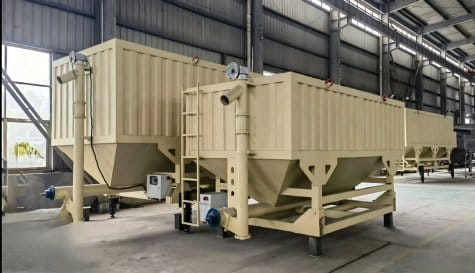
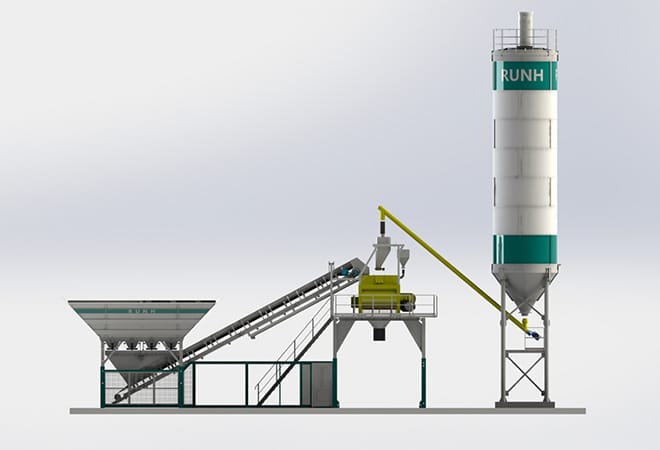
For example, RUNH cement silos feature a modular design and high-strength structure, facilitating transport and on-site assembly, thereby reducing the risk of installation errors.

3. Safety Preparations

  • Professional installation team
  • Designate a hoisting supervisor
  • Provide safety ropes for work at height

Personnel must not stand beneath heavy loads during hoisting

👉 Further reading:
What Is a Concrete Batching Plant and How Does It Work?

cement silo installation

III. Steps for Installing Cement Silos

1. Foundation Pouring and Alignment

  • Ensure levelness and centre alignment
  • Allow the concrete to cure for at least 7 days
  • Check the position of the embedded parts

2. Silo Lifting and Positioning

  • Lift the silo in sections using a crane
  • Operate steadily and slowly
  • Align precisely with the foundation

Lifting is a high-risk operation and must be carried out by a professional team

3. Verticality Alignment

  • Check verticality using surveying instruments
  • Deviations must be kept within the permissible range

👉 Tilting will result in uneven stress distribution, which may cause structural damage over time

4. Fixing and Connections

Check all connections:

  • Whether flange seals are tight
  • Whether bolts are tightened
  • Whether welded joints are secure

5. Installation of Accessories

Including:

  • Dust collector
  • Level gauge
  • Safety valve
  • Arch-breaking device
  • Screw conveyor interface

6. Commissioning and Trial Run

  • Inspect the pneumatic conveying system
  • Test the pressure relief devices
  • Verify dust collection efficiency

👉 Recommended reading:

Installation Timeline for a Concrete Batching Plant

IV. Key Safety Points for the Installation and Operation of Cement Silos

1. Lifting Safety

  • Lifting operations must be directed by a designated person
  • Avoid working in adverse weather conditions
  • Prevent hooks from coming loose or the structure from swaying

2. Safety for Work at Height

  • Use safety harnesses
  • Install guardrails
  • Prevent falls

3. Lightning Protection and Wind Resistance Measures

If the silo is of considerable height:

  • Install lightning protection devices
  • Reinforce wind-resistant structures

Increase guy wire anchoring, particularly in areas prone to strong winds

4. Dust and Pressure Safety

  • Install a dust extraction system
  • Fit pressure relief valves
  • Prevent excessive pressure inside the silo

5. Prevention of Arching and Material Blockages

  • Use arch-breaking devices
  • Regularly inspect discharge outlets
  • Keep materials dry

V. Operation and Maintenance Management

1. Regular Inspections

  • Check for structural deformation or corrosion
  • Check for loose bolts
  • Check for pipe leaks

2. Cleaning and Maintenance

After prolonged use:

  • Dust may have clumped together
  • Material may have become blocked inside

Dust removal equipment must be cleaned and inspected regularly

3. Operational Monitoring

Recommended key monitoring points:

  • Changes in the material level
  • Changes in pressure
  • Discharge conditions

👉 Further Reading:
Crushing Plant Cost Breakdown: Equipment, Installation and Operation

VI. Common Risks and Preventive Measures

Risks Reasons: Solutions:
Tilting or subsidence Unstable base Reinforce the foundation design:
Structural deformation Incorrect installation Check vertical alignment:
Dust pollution Insufficient dust removal Replace the filter cartridge:
Material blockage Humidity or clumping Use a de-arching device

Conclusion:

The installation and safety management of cement silos constitute a systematic process that requires comprehensive control from the design stage through to operation and maintenance.

Through standardised operations, the following can be achieved:

  • Improved production stability
  • Reduced safety risks
  • Extended equipment service life

As a specialist manufacturer of engineering machinery, RUNH provides high-quality cement silos and comprehensive solutions to help customers achieve safe and efficient production operations.
 

According to the actual situation, we will work out a flexible investment solution for you.
According to local market demands, we will guide users to choose the right product category.
According to production demand and investment scale, we will guide users to choose the right equipment.

If you are looking for related products or have any other questions, please feel free to contact us.
Have Other Questions For Us? Ask Our Experts Directly!
Submit a Quick Quote
We can ensure that our customers receive the highest quality prices and services.


    Submit a Quick Quote
    We can ensure that our customers receive the highest quality prices and services.